
INNOVA IMPLANT CENTER · PATIENT GUIDE
“Teeth in a Day” Sounds Amazing—But What’s the Catch?
You have seen the ads: failing teeth out, implants in, a new smile in a day. Perhaps you have already had a consultation, discussed financing, and pictured yourself smiling without covering your mouth.
Then comes the question: “It sounds amazing—but what’s the catch?”
Teeth in a day can be real. The catch is that receiving fixed teeth does not mean your implants have healed or your treatment is finished. Your first set may be temporary, and the advertised price may not describe every stage of your individual treatment.
A compelling promise deserves a clear explanation. What teeth will you receive? What happens after surgery? And does the price cover the smile you expect to keep?
You should not have to discover the answers after committing to treatment.
Can You Really Get Teeth in a Day?
Yes. Suitable patients can receive dental implants and a fixed set of replacement teeth on the same day. However, this requires advance planning, adequate implant stability, and follow-up care. In many treatment plans, the first teeth are temporary, with the final set made after healing.
The phrase describes an important treatment milestone. It does not describe every appointment involved. Learn more about our teeth-in-a-day treatment and discuss the steps your individual plan would require.
Before surgery, your team needs to examine your mouth, review your health, assess your scans, and plan the replacement teeth. They should also explain which teeth need removal and whether reasonable alternatives exist.
In addition, clarify the actual delivery schedule. Does the office mean teeth on surgery day, the following day, or another date?
Those differences matter when you are arranging time off, transportation, and help at home.
So, What’s the Catch?
The catch is that receiving teeth in one day does not mean your implants have healed, you can eat anything, or your treatment is finished. The promise needs an explanation of the teeth you receive, the restrictions during healing, and any later treatment.
Initially, implants rely on their stability in the jaw. Over the following weeks and months, the bone heals around and bonds with them. Even if your new teeth feel secure, that healing still needs protection.
That is why a dramatic before-and-after photograph cannot tell you the whole story. It does not show the diet instructions, review appointments, or later changes to the teeth.
The missing explanation is what matters: which teeth, which restrictions, which follow-up visits, and which costs? A headline cannot answer all of that. Your treatment plan should.
Does “Permanent” Mean You’re Getting Your Final Teeth?
“Permanent” does not necessarily mean “final.” Fixed teeth stay attached to your implants rather than coming out at home. However, a temporary healing bridge can also be fixed. Ask whether the first set is intended for long-term use or will be replaced after healing.
That distinction can disappear in a quick sales conversation. Yet it changes what you should expect from the treatment, the timeline, and the fee.
- Fixed teeth
- Teeth attached to implants; you do not take them out at home. Your clinician can remove a screw-retained set when needed.
- Temporary or provisional teeth
- A set used during a treatment stage, often while you heal and the team evaluates your smile and bite.
- Final or definitive teeth
- The set intended for long-term use. It still requires cleaning, professional care, and possible future repair or replacement.
A temporary bridge is not automatically a compromise or a sign of poor care. It can be an intentional part of the plan while your mouth heals and your team evaluates your bite, speech, and smile.
The concern is being sold one expectation and receiving something different. If another set of teeth is planned, you should know that before surgery—not learn it at a follow-up visit.
Ask this directly:
“Are these the teeth I am expected to keep long term, or will you make another set after healing?”
Then ask whether that later set is included in your treatment fee.
Also, no restoration is indestructible. “Permanent” should never be understood as “guaranteed to last forever without maintenance.”
Why Do Some Offices Offer Final Teeth Immediately While Others Wait?
Treatment approaches differ. Some provide an early definitive restoration, while others use temporary teeth before making the final set. The important questions are why the approach suits your mouth and how the team will manage changes during healing.
A temporary set can serve a useful purpose. It gives you and your clinician an opportunity to assess appearance, speech, comfort, and bite before completing the final restoration.
Meanwhile, the tissues around your implants can change as they heal. Those changes may affect the space beneath the bridge and how easily you can keep it clean.
An early final restoration therefore needs a follow-up plan, too. A material such as zirconia does not eliminate healing or the possibility of adjustments. Likewise, a space beneath a bridge does not automatically indicate failure; the design must also allow effective cleaning. Persistent food trapping, discomfort, or difficulty cleaning deserves evaluation.
“Final teeth tomorrow” should come with an answer to “What if my mouth changes afterward?”
Ask: “If the fit changes after healing, what happens next—and who pays for an adjustment or remake?”
You can also ask who designs and makes your teeth. An in-house lab may help the team coordinate design changes and repairs. However, neither an in-house lab nor an outside lab tells you, by itself, how well your teeth will fit or whether revisions are included. Ask who handles a problem and what the written policy covers.
For a closer look at restoration timing and materials, read our Innova Prosthodontics guide to zirconia teeth in 24 hours.
What Happens After the First Day?
After surgery, you still need healing time, dietary restrictions, cleaning instructions, and follow-up appointments. If your first teeth are temporary, later visits may include new scans, a trial version of your smile, and delivery of the final teeth.
The American Dental Association explains that bone needs time to heal around dental implants, even when replacement teeth are attached on the day of surgery.
For the first stage, follow the eating restrictions your surgical team gives you. Teeth that feel firm are not permission to test them with hard or chewy food.
Next, your team checks healing, comfort, and the way your teeth meet. This is also the time to report trouble speaking, areas that are difficult to clean, or changes in your bite.
Once healing is sufficient, a staged treatment plan moves toward the final restoration. The timing depends on your individual progress; it should not be treated as a guaranteed calendar deadline.
Finally, care continues after the final teeth are delivered. Daily cleaning and professional maintenance remain part of protecting your implants, as described in the American College of Prosthodontists’ guidance on maintaining full-arch implant restorations.
What If You Can’t Receive Fixed Teeth on Surgery Day?
If the implants are not stable enough for an immediate fixed bridge, your clinician may need to change the plan and allow healing first. Your consultation should explain the backup arrangement, any temporary removable option, and how this would affect your timeline and cost.
A scan helps your team plan, but some decisions depend on what they find during surgery.
Waiting when necessary can be a protective decision. It does not automatically mean the treatment has failed.
If avoiding a removable denture is a major reason you are seeking implants, say so. That concern deserves a realistic discussion. However, protecting healing should take priority over delivering a fixed bridge just to meet an advertised deadline.
You deserve to know what that situation would look like before you arrive for surgery. Ask what you would wear, when it could be fitted, and how the team would support you during healing.
What Does Your Teeth-in-a-Day Price Actually Include?
A useful quote identifies the surgery, the teeth provided at each stage, their materials, and the follow-up care included. If a final set comes later, confirm its cost in writing. Otherwise, two similar-looking offers may cover different treatment.
Two offers can use the same words—“teeth in a day”—and still include different things. One may include temporary and final teeth. Another may price the first stage separately or offer optional upgrades. Verify the actual proposal rather than assuming either arrangement.
A lower price does not automatically mean poor care. Likewise, a higher price does not automatically mean everything is included. The material and manufacturing method alone do not tell you whether the restoration is appropriate for its intended role.
Before comparing totals, check these items:
- Records and planning
- Are the examination, scans, and treatment planning included?
- Surgery
- Which extractions, implants, and any anticipated additional procedures are covered?
- Sedation or anesthesia
- What is planned, who provides it, and is there a separate fee?
- First set of teeth
- Is it fixed or removable, temporary or final, and what material is used?
- Final teeth
- Are they included? Is a later material upgrade optional or expected?
- Follow-up care
- Which reviews and adjustments are included, and for how long?
- Repairs and remakes
- What is covered if teeth break or the fit needs changing? What conditions apply?
- Ongoing maintenance
- What professional care is needed, and what will it cost separately?
The phrase “starting at” is not a complete treatment proposal. Ask for the expected total for your situation and the circumstances that could change it. If monthly payments are discussed, also ask for the total treatment cost and financing terms. A monthly figure does not tell you what the complete treatment includes.
What Should You Ask Before Saying Yes?
Before accepting a teeth-in-a-day plan, clarify what you receive, what remains afterward, what could change, and what the fee covers. Ask the treating clinician to explain the clinical decisions and have the office document the financial details.
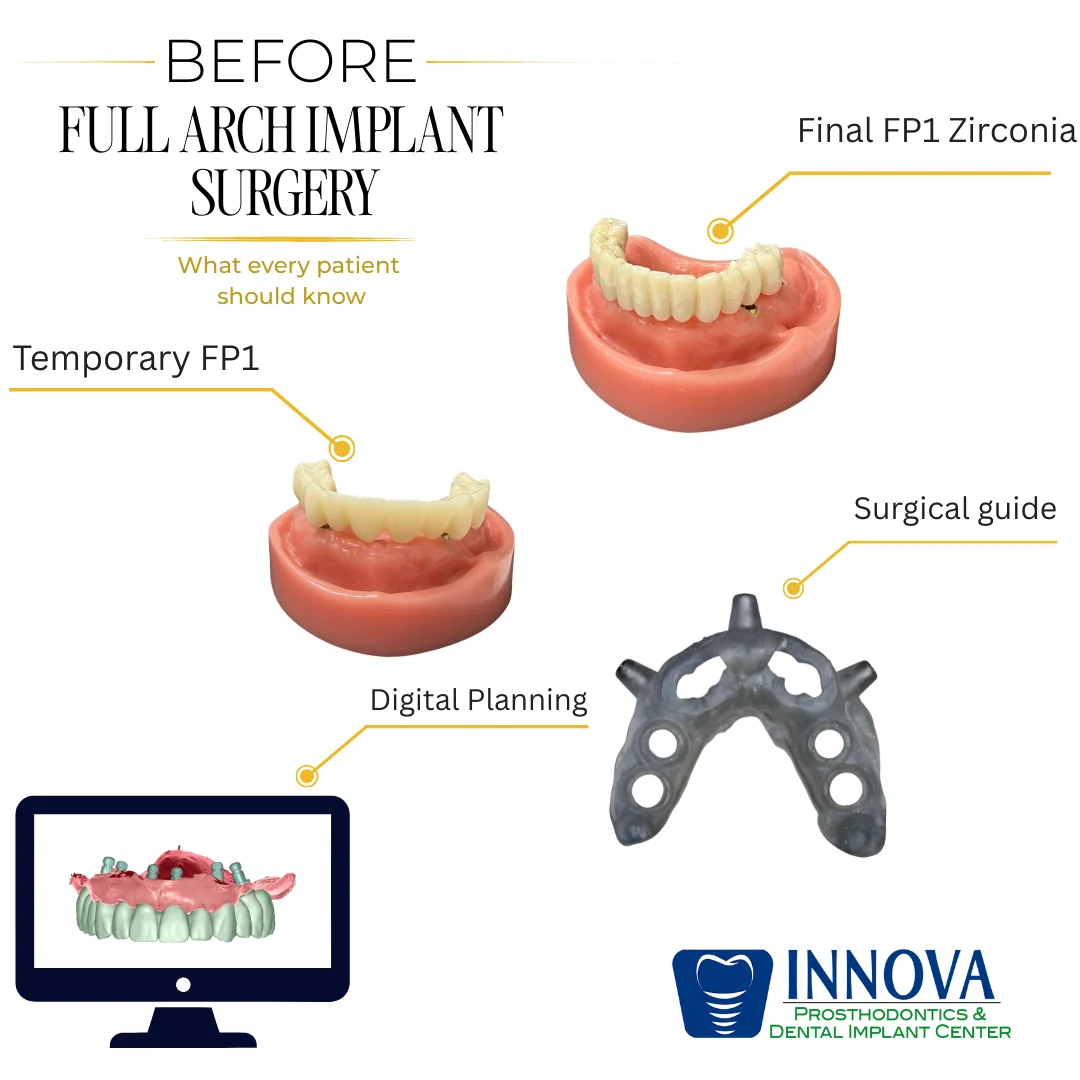
If you are comparing designs with and without replacement gum material, ask whether FP1 full-arch treatment is appropriate for your mouth. The number of implants and the design of the replacement teeth are separate parts of the treatment plan.
Bring these questions to your next visit:
- Why is this treatment appropriate for my mouth, and what alternatives do I have?
- Which teeth will I receive on surgery day or the following day?
- Are they temporary or final, and what are they made from?
- What can I eat, and how will I clean around them during healing?
- What is the backup plan if fixed teeth cannot be delivered as expected?
- Will I have a chance to review the appearance and bite before the final set is completed?
- What happens if healing changes the fit or I need a repair?
- Does my written quote cover the full proposed treatment, and what ongoing costs remain?
You do not need to become an implant expert to ask for a complete explanation. You are making a decision about your health, appearance, and finances. Taking time to understand it is reasonable.
Still Unsure About Your Treatment Plan?
A second opinion can help you understand the proposed treatment, compare alternatives, and clarify what is included before you commit. It can also confirm that the original recommendation is reasonable. You do not have to prove something is wrong before asking for another professional opinion.
If you have already received a teeth-in-a-day proposal, bring the written plan and fee estimate. Ask about sharing any existing scans and records for review.
At Innova Implant Center, you can request a second-opinion consultation with Dr. Elias Rivera, a board-certified prosthodontist, to discuss the proposed treatment and your questions.
You should be able to explain, in your own words, which teeth you will receive, what happens after surgery, and what you are paying for.
Before you say yes to the promise, make sure you understand the plan.
Request a Second-Opinion Consultation at Innova Implant Center



Leave A Comment